.png)

High Security Entrance Doors Bristol: The Architectural Guide to Secure Home Design

Updated: Jul 18
For too long, homeowners have been forced to choose between a front door that looks like a bank vault and one that actually complements their home's architecture. You shouldn't have to sacrifice your property's kerb appeal just to feel safe in your own hallway. In busy urban areas, the desire for robust protection is often met with bulky, unattractive options or a maze of technical jargon that makes the decision feel unnecessarily complex. We understand that your home is both a sanctuary and a significant architectural investment.
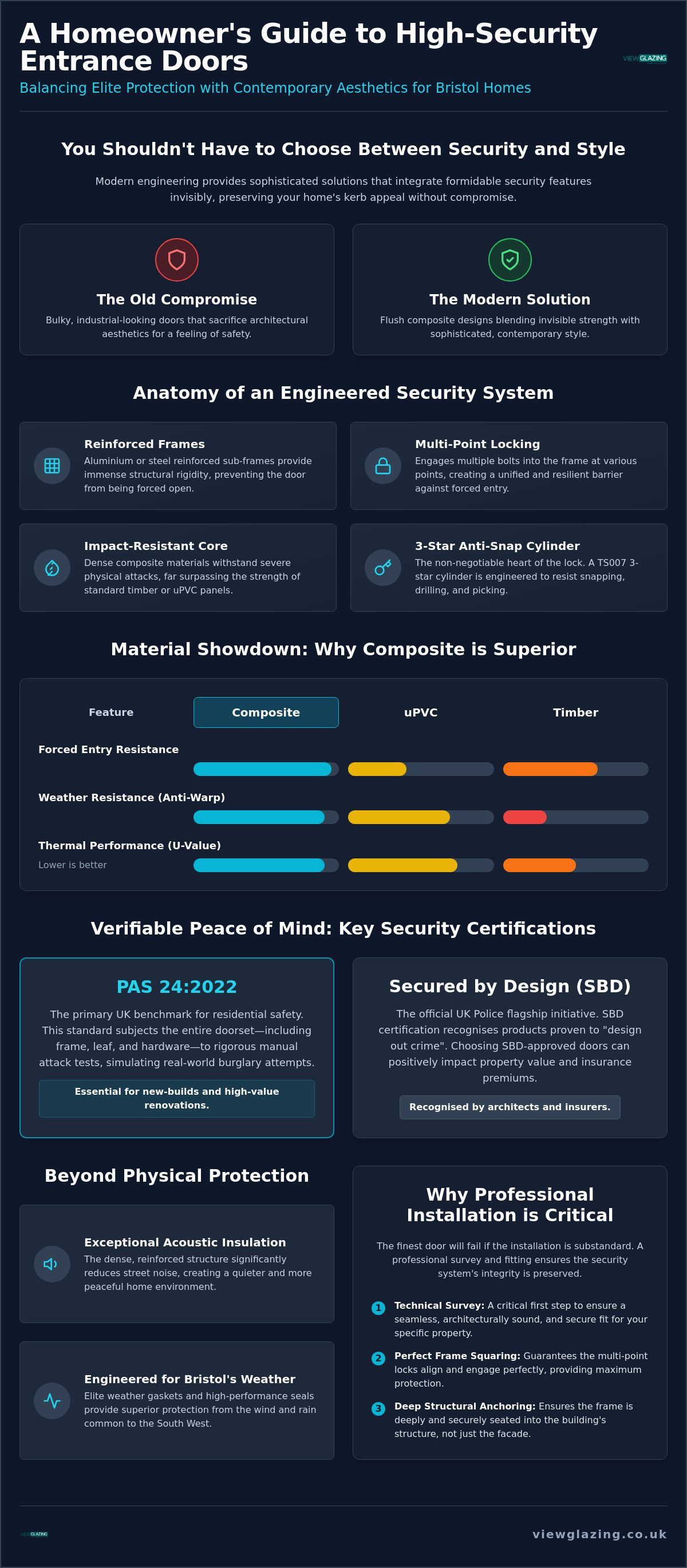
This guide demonstrates how to specify high security entrance doors Bristol homeowners can trust for elite protection, all whilst maintaining a sophisticated, contemporary aesthetic and exceptional thermal performance. You'll discover how modern engineering allows for invisible security features that meet the rigorous PAS 24:2022 standards without the industrial look. We will preview the benefits of flush composite designs and show you how a professional, local installation ensures your peace of mind is built into the very fabric of your home.
Table of Contents
What Defines High Security Entrance Doors in Bristol?
A truly secure entrance is far more than just a heavy slab of material; it is a meticulously engineered system where every component works in unison. For homeowners seeking high security entrance doors Bristol, the definition of safety has evolved from industrial-looking barriers to sophisticated architectural solutions. These systems integrate reinforced sub-frames, advanced multi-point locking mechanisms, and impact-resistant panels into a single, cohesive unit. This holistic approach ensures that the door remains a formidable deterrent without sacrificing the aesthetic harmony of a modern home.
Standard uPVC or traditional timber doors often struggle to meet contemporary security requirements in urban environments. Timber can warp or swell over time, potentially misaligning the locking points, whilst uPVC lacks the inherent structural rigidity needed to withstand determined forced entry. By contrast, modern high-security doors utilise composite cores and aluminium reinforcements to maintain their shape and strength for decades. For those seeking a comprehensive overview of door security, it's clear that the synergy between the frame, the hardware, and the leaf is what creates a truly resilient barrier.
The shift from industrial steel slabs to contemporary architectural entrance solutions means you no longer have to compromise on kerb appeal. Modern flush composite doors provide the same level of protection as a vault door but are finished in textures and colours that complement a high-end residential project. However, the finest door in the world will fail if the installation is substandard. Professional installation is critical to ensure the frame is perfectly squared and the anchors are deeply seated into the building's structure, preserving the integrity of the security system.
The Security Landscape in the South West
Property needs across Bristol vary significantly, from the high-density Victorian terraces of Redland to the more exposed, contemporary builds on the city's outskirts. Urban properties often face different risks than rural retreats, leading many homeowners to move away from "off-the-shelf" DIY kits that offer a one-size-fits-all approach. Specifying a bespoke system isn't just about physical safety; it's often a prerequisite for comprehensive home insurance policies, which increasingly demand certified standards for new installations.
Beyond Physical Protection: The Invisible Benefits
The heavy-duty engineering required for security brings several welcome secondary benefits to a Bristol home. The dense, reinforced structures of high security entrance doors Bristol provide exceptional acoustic insulation, significantly reducing street noise in busy neighbourhoods. This structural density also prevents the mechanical fatigue common in cheaper doors, ensuring that the hinges and locks operate smoothly year after year. Secured by Design is the official UK police flagship initiative that supports the principles of "designing out crime" through the use of high-quality, tested security products.
The security of your home relies on verifiable data rather than marketing claims. In the UK, the
serves as the primary benchmark for residential safety. It is a "product enhanced security" requirement that tests the entire doorset as a single unit, including the frame, hardware, and glazing. This certification is a legal requirement for new-build homes under Building Regulations, but it is equally vital for renovation projects involving
high security entrance doors Bristol
residents can trust. Beyond the British standard, you may encounter European RC (Resistance Class) ratings. RC2 is the common residential standard, designed to resist opportunistic burglars using simple tools for at least three minutes, whilst RC3 offers a higher tier of protection against more experienced intruders using heavy-duty crowbars and drills. Secured by Design (SBD) is another term frequently mentioned by architects and insurers. This is the official UK police flagship initiative that recognises products capable of deterring and reducing crime. Choosing SBD-certified doors can positively impact property value and insurance premiums, as it signals a permanent commitment to safety. Within these doors, the lock cylinder remains the most vulnerable point. A 3-star TS007 cylinder is non-negotiable; it is specifically engineered to resist "snapping", a common method of entry where the lock core is broken to bypass the multi-point system.
For homeowners looking to upgrade their current security or seeking expert advice on high-specification cylinders and key systems, you can learn more about London Locks - Locksmiths Keys and Fobs.
How Doors are Tested for Intruder Resistance
Testing is a rigorous, physical process that simulates real-world burglary attempts. Engineers conduct "manual attack" tests using a variety of tools, including chisels and screwdrivers, to identify any weak points in the door's structure. Impact testing involves swinging a heavy mechanical ram against the glazing and panels to ensure they won't shatter or dislodge under force. However, the door is only as strong as its fixings. A high-security installation ensures the frame-to-wall connection is reinforced, preventing the entire unit from being pried away from the masonry.
The Role of Multi-Point Locking Systems
Modern security relies on multiple points of engagement. When you turn the key or lift the handle, a series of hardened steel hooks, bolts, and deadlatches move in unison to lock the door into the frame at several heights. This distributes any force applied to the door across its entire length, making it nearly impossible to lever open. For many new builds in the South West, electronic or smart locking integration is becoming the standard, allowing for keyless entry without compromising these physical safeguards. You can consult our Glazing Project Management guide for detailed advice on technical specifications. If you are ready to discuss the specific requirements for your property, you can reach out to our technical team for a consultation.
Composite vs Steel: Choosing the Right Material for Your Home
Selecting the right material is a pivotal decision in the design process. Whilst industrial steel has long been the default for high-security applications, modern residential architecture demands a more refined balance between strength and soul. For high security entrance doors Bristol homeowners typically find that composite materials provide a superior blend of architectural elegance and practical durability. Unlike steel, which can feel cold and institutional, composite doors allow for a vast range of finishes and textures that mimic the warmth of natural timber without its inherent vulnerabilities.
Thermal efficiency is another area where composite materials excel. Steel is a natural conductor of heat, which can lead to significant thermal bridging and energy loss unless complex thermal breaks are installed. Composite doors are engineered with high-density, insulating cores that help properties meet the upcoming Future Homes Standard requirements. In the damp, maritime climate of the South West, these doors offer a significant advantage over traditional timber, as they will not rot, swell, or warp when exposed to wind-driven rain. For a deeper look at how these materials stack up against other alternatives, you can explore our architectural comparison of Composite vs uPVC Doors.
The Rise of Flush Composite Entrance Doors
Architects are increasingly specifying flush composite designs for contemporary Bristol projects. These doors feature a high-density structural core encased in reinforced outer skins, creating a sleek, minimalist profile that sits perfectly level with the frame. This "flush" look is highly sought after for its clean lines and lack of traditional decorative mouldings. It also allows homeowners to create a cohesive exterior by matching their entrance with VELFAC Windows Bristol, ensuring that the glazing and entrance systems share a unified design language.
When Steel Still Makes Sense
Steel remains a valid choice for specific commercial applications or high-risk industrial environments where aesthetic warmth is less of a priority than raw impact resistance. However, there is a common misconception that composite is "lesser" than steel for residential use. In reality, when tested against PAS 24 security standards, high-quality composite doors provide a level of protection that is more than sufficient for any domestic setting. They offer a "warm" architectural finish that integrates seamlessly with a home's interior, avoiding the industrial aesthetic of steel whilst providing high security entrance doors Bristol residents can rely on for decades.
Specifying for the South West: Weathering and Performance
In the South West, the performance of an entrance system is tested daily by more than just security threats. The wind-driven rain common across the Bristol hills and the coastal reaches of the Severn Estuary can be relentless. High security entrance doors Bristol homeowners specify must be engineered to withstand this moisture ingress over many decades. A door that offers elite protection but fails to keep out the damp is a poor architectural investment. Fortunately, the heavy-duty seals required to meet high-tier security ratings also serve as elite weather gaskets, creating a dual-purpose barrier that prevents both intruders and draughts from entering your home.
Longevity also depends on how a finish handles the sun. For south-facing entrances, particularly in the exposed Cotswolds, UV-stable finishes are essential to prevent the colour fading or the surface cracking that often plagues cheaper alternatives. Beyond the physical structure, your door must comply with Approved Document L of the Building Regulations. With the Future Homes Standard bringing in stricter energy efficiency requirements, including a maximum U-value of 1.4 W/m²K for replacement doors and 0.8 W/m²K for new builds from March 2027, ensuring your entrance meets these targets is vital. View Glazing’s detailed technical survey ensures a millimetre-perfect fit for optimum performance, preventing the thermal leaks that occur with poorly sized installations.
Thermal Performance and U-Values
A secure door should never be a thermal liability. The reinforced cores that provide impact resistance also act as exceptional insulators, helping to lower heating bills by maintaining a consistent internal temperature. Modern engineering allows us to integrate high-security glazing into these systems using triple-pane units and argon gas fills. This ensures you can enjoy natural light in your hallway without compromising the building's thermal envelope or its security rating.
Architectural Integration in Bristol Renovations
Bristol's architectural diversity requires a nuanced approach to specification. The requirements for a Victorian terrace in Clifton, where traditional proportions are paramount, differ vastly from a modern Harbourside apartment with floor-to-ceiling glazing. We often specify side-lights and over-lights to increase light flow, using reinforced glass that matches the door's security certification. This allows for a grand architectural statement that remains entirely secure. If you are planning a renovation or new build, you can contact our specialist team to discuss the technical requirements for your project.
The View Glazing Approach: Professional Installation in Bristol
The final and perhaps most critical stage in securing your property is the installation. Even the most advanced high security entrance doors Bristol has to offer will underperform if they're poorly fitted or misaligned. At View Glazing, we treat the entrance as a piece of architectural engineering rather than a mere commodity. Our process begins with a comprehensive technical survey to identify the specific structural requirements of your building. This ensures that the frame's anchor points are seated deeply into sound masonry, providing the necessary foundation for the multi-point locking systems and reinforced hinges to operate with the precision they were designed for.
Our project management service removes the stress of sourcing by handling the entire procurement process from premium manufacturers. We act as a dedicated partner, ensuring that the technical specifications discussed in earlier sections are met without compromise. Our installers are architectural glazing specialists who understand how to balance security with delicate finishes. If you're looking to extend this level of security and design across your entire property, we invite you to view our guide on Cortizo Sliding Doors for a complete home transformation.
From Survey to Handover: Our Process
The journey for a homeowner or developer is designed to be methodical and transparent. After the initial survey, we coordinate directly with other trades on-site, which is particularly vital for new-build projects where scheduling is complex. Once the installation is complete, our specialists perform rigorous final security testing to ensure every bolt and hook engages perfectly. We then provide a full handover of certification documents, including PAS 24 compliance records, giving you permanent proof of your home's security standards.
Why Local Expertise Matters
Choosing a local specialist provides advantages that nationwide suppliers simply cannot match. We have a deep understanding of Bristol's diverse building styles, from the pennant stone of Victorian villas to the specific planning nuances of the city's conservation areas. This local insight ensures that your installation is both sympathetic to the local vernacular and technically sound, providing the high security entrance doors Bristol properties require for long-term protection. Having a local point of contact also means that any future adjustments or maintenance are handled by the same experts who know your project's history. To begin your journey toward a more secure and elegant home, you can contact View Glazing for a professional entrance door consultation.
Securing Your Architectural Vision in the South West
Investing in high security entrance doors Bristol homeowners can trust is about more than just choosing hardware; it's about integrating safety into the very design of your property. We've explored how modern flush composite systems provide a sophisticated alternative to industrial steel, offering elite protection whilst meeting the latest thermal standards. By prioritising certified standards like PAS 24:2022 and ensuring your entrance is specified for the unique South West climate, you create a sanctuary that is as beautiful as it is resilient.
As specialists in VELFAC and Rationel systems, View Glazing provides comprehensive architectural glazing project management to bring your specific vision to life. Our expert local installation ensures that every technical detail, from reinforced frames to millimetre-perfect seals, performs exactly as intended. We act as your dedicated partner, guiding you from the initial concept to the final handover of certification. Request a Technical Survey for Your Bristol Project and take the first step towards a more secure, energy-efficient, and elegantly designed home.
Frequently Asked Questions
What is the most secure type of entrance door for a residential home?
Flush composite doors are widely considered the most secure option for high security entrance doors Bristol projects. These systems combine a high-density insulating core with reinforced outer skins and integrated multi-point locking mechanisms. Unlike standard timber or uPVC, these doors are engineered to resist warping and structural fatigue, ensuring the security hardware remains perfectly aligned for decades of reliable protection.
Does a high-security door help with home insurance premiums in Bristol?
Installing high security entrance doors Bristol homeowners can trust often leads to lower insurance premiums or is a mandatory requirement for comprehensive cover. Most UK insurers specify that entrance doors must meet PAS 24 or Secured by Design standards to validate a policy. We recommend informing your provider of the specific certifications and professional installation to ensure you receive any available security discounts.
Can I have a glazed entrance door that is still high-security?
You can absolutely specify a glazed entrance door without compromising on safety. High-security glazed units utilise laminated, impact-resistant glass that is held in place by reinforced glazing beads to prevent removal from the outside. These systems undergo the same rigorous manual attack and ram tests as solid panels to ensure they meet the PAS 24:2022 requirements for intruder resistance.
What is the difference between PAS 24 and Secured by Design?
PAS 24 is a specific British testing standard that measures the physical resistance of a doorset against common burglary methods. Secured by Design is a broader police-led initiative that requires products to meet PAS 24 whilst also ensuring the manufacturer maintains consistent quality through regular audits. Whilst PAS 24 is the technical benchmark, Secured by Design provides an additional layer of police-recognised accreditation.
How much do high-security entrance doors typically cost in the UK?
The cost of a high-security entrance system depends on several architectural variables, including the chosen material, the complexity of the glazing, and the specific security rating required. Bespoke flush composite doors involve significant engineering to balance thermal performance with intruder resistance. We recommend a technical survey to identify the structural requirements of your property before receiving a tailored specification for your project.
How long does it take to install a new high-security front door?
A professional installation usually takes one full working day for a standard replacement door. However, the entire journey from the initial technical survey and bespoke manufacturing to the final handover of certification documents takes several weeks. This methodical pace ensures that your door is built to your exact millimetre-perfect measurements, which is essential for maintaining its security and thermal integrity.
Are smart locks as secure as traditional multi-point locking systems?
Smart locks are highly secure when they are integrated with a certified physical multi-point locking system. The primary security of the door still relies on the strength of the hooks and bolts engaging with the frame. When choosing electronic access, ensure the system uses high-level encryption and is paired with a 3-star TS007 cylinder to protect against physical tampering and lock snapping.
Do high-security doors require special maintenance?
Modern high-security composite doors require very little maintenance compared to traditional timber alternatives. To ensure the hardware continues to operate smoothly, we recommend cleaning the door surface with warm soapy water and applying a light lubricant to the multi-point locking mechanism and hinges once a year. This simple routine prevents mechanical fatigue and ensures the door remains a reliable barrier for its entire lifespan.
Comments