

Reducing Traffic Noise with New Windows in Salisbury

A new window can reduce traffic noise, but the glazing is only part of the answer. Reducing traffic noise with new windows in Salisbury depends on the complete window, including its seals, frame and installation; even small gaps can undermine sound insulation. A 10 dB reduction is perceived as cutting noise in half, so the right specification can make a noticeable difference indoors.
It’s understandable to focus on double or triple glazing when traffic noise disrupts the peace at home. But extra or thicker panes alone don’t guarantee a quieter room if a window fails to close tightly or sound can pass around the frame.
This guide explains how glazing choices, window condition and installation details affect road noise, and why the whole window matters more than any single material or headline figure.
You’ll also learn what to consider if your home is listed or part of a managed estate, where changing existing windows may require careful planning. The aim is to help you weigh the options and make a considered decision that respects your property as well as your comfort.
Table of Contents
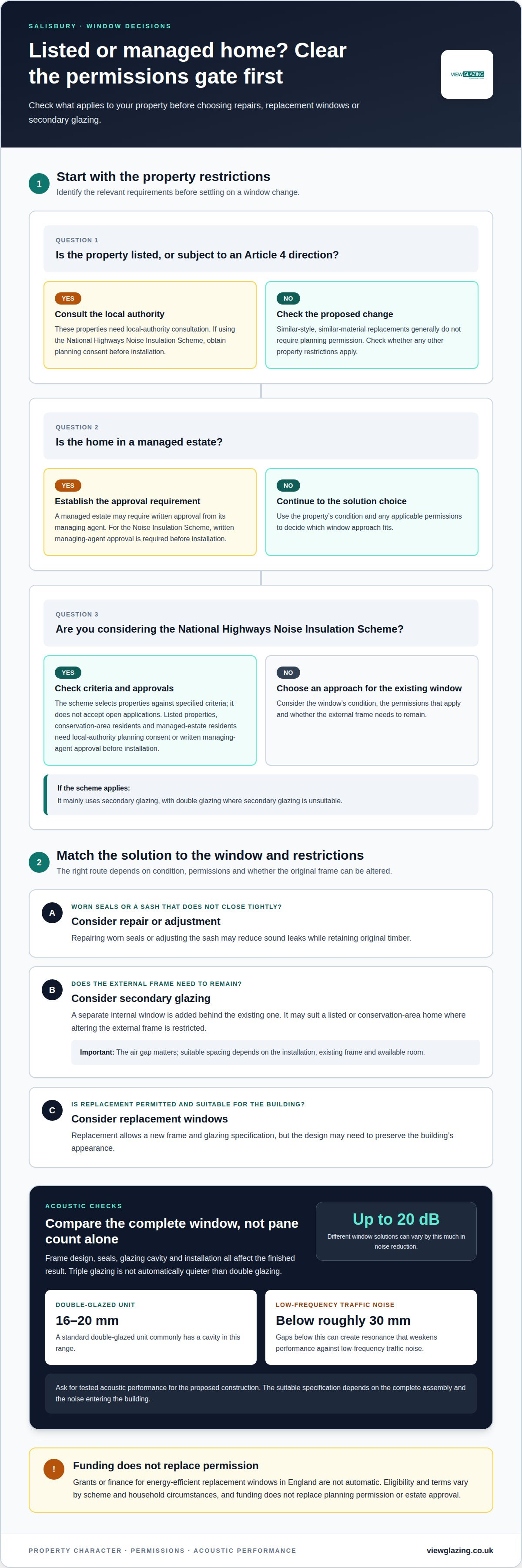
What if I live in a listed property or managed estate?
In Salisbury, a listed building or managed estate can affect which window changes are acceptable. Start by identifying the property’s restrictions before choosing repairs, replacement windows or secondary glazing. Similar-style, similar-material replacements generally do not require planning permission, but listed buildings and properties subject to an Article 4 direction need local-authority consultation. Managed estates may also require written approval from their managing agent.
For homes covered by the National Highways Noise Insulation Scheme, owners of listed properties, residents in conservation areas and residents of managed estates must obtain local-authority planning consent or written managing-agent approval before installation. The scheme mainly uses secondary glazing, with double glazing where secondary glazing is unsuitable. It selects properties against specified criteria rather than accepting open applications.
Whether to repair or replace depends on the existing window’s condition and any applicable permissions. Repairing worn seals or adjusting a sash so it closes more tightly may address sound leaks while retaining original timber. Replacement allows for a new frame and glazing specification, but the design may need to preserve the building’s appearance. Secondary glazing adds a separate internal window behind the existing one, which can help when the external frame needs to remain.
Grants or finance for energy-efficient replacement windows in England depend on the scheme and are not automatic. Eligibility and terms vary by scheme and household circumstances. Funding does not replace planning permission or estate approval.
Glazing choice also matters. A standard double-glazed unit commonly has a 16 to 20 mm cavity, while gaps below roughly 30 mm can create resonance that weakens performance against low-frequency traffic noise. Triple glazing is not automatically quieter than double glazing. Compare the tested acoustic performance of the proposed construction, rather than choosing by pane count alone. Different window solutions can vary by up to 20 dB in noise reduction.
Secondary glazing creates a separate air gap and may suit a listed or conservation-area home where altering the external frame is restricted. For acoustic performance, the gap between the original window and secondary pane matters, and the suitable spacing depends on the installation. The right arrangement depends on the existing frame, available room and the noise entering the building.
Tailoring the design means assessing the whole opening, not just the glass. A professional survey can take account of property restrictions, frame condition, the glazing cavity and installation details. This helps balance noise reduction with the home’s character, whether the right approach is repairing original timber, replacing a permitted window or adding secondary glazing.
Can windows reduce traffic noise?
The right window can reduce road noise indoors, but performance depends on more than the glass. If you’re reducing traffic noise with new windows in Salisbury, the specification should reflect the room, the exposed façade and the condition of each opening.
Acoustic Laminated Glass
Acoustic laminated glass has an interlayer between sheets of glass to help damp vibration. It can be worth considering where traffic noise is intrusive, particularly if ordinary glazing hasn’t provided the desired sound insulation.
One example combines an 8 mm laminated pane with a 6 mm toughened pane. Acoustic laminated glass can reduce transmitted noise by 10 to 15 dB more than standard double glazing. The benefit depends on the complete window construction, so a glass specification alone cannot describe how much noise will enter a room.
Pane Thickness and Noise Reduction
Pane thickness affects how a glazing unit responds to sound, but thicker glass alone does not determine the right specification. Unequal pane thicknesses can help avoid matching weaknesses across a unit, while an interlayer can damp vibration.
For example, an 8 mm laminated pane paired with a 6 mm toughened pane uses unequal thicknesses. The frame and seals remain part of the result. A professional specification considers whether the complete assembly suits the opening and the noise affecting the room, rather than treating either pane as a standalone solution.
Surveys and Acoustic Assessments
A property survey assesses window openings and surrounding details that may contribute to noise. It can help establish whether sound is passing through the glazing, a ventilation opening, a worn seal or the joint between frame and wall.
An acoustic assessment can compare the proposed construction’s tested performance with the noise issue in the affected room. When reducing traffic noise with new windows in Salisbury, this helps distinguish a glazing problem from sound entering elsewhere, such as through another opening or an untreated wall.
Draught-proofing can address air gaps in an existing window, but it does not turn ordinary single glazing into acoustic glazing. It may reduce window noise by a few decibels. Don’t simply block existing ventilation openings, as rooms still need a suitable airflow arrangement. Acoustic ventilators may be considered as part of the overall solution.
Testing figures should describe the complete window, not just the glass. Frame design, seals and installation all affect the finished result, and no window blocks all sound. Before settling on a specification, assess the noise route, window condition and ventilation together.
To discuss a suitable window survey and acoustic specification, get in touch.
Window sound insulation measurements and standards
Acoustic figures can help you compare window constructions, but the measurement method matters. For road traffic, look for ratings that account for traffic noise and describe the complete window, not just its glass.
Laboratory sound insulation measurements use a range of frequencies, and the measurement method matters when comparing results. DS ISO 10140 covers laboratory testing, while field measurements use DS ISO 16283-3. The single-number rating is calculated using DS ISO 717-1. For traffic noise, the usual figures are Rw+Ctr for laboratory measurements and R’w+Ctr for field measurements. The Ctr adjustment accounts for the character of road traffic noise.
A stated Rw value alone can give an incomplete picture. Standard double glazing has an Rw rating of 28-32 dB, but the traffic-noise rating adds useful context. Compare like with like: a laboratory rating applies to the tested construction, while a field result reflects the window in its installed setting. Glass thickness, frame, seals and fitting all contribute to the complete assembly’s performance. No noise-reduction window blocks 100% of sound energy.
Sound insulation and thermal insulation describe different performance measures. Thermal performance is expressed as a U-value, while acoustic ratings describe sound transmission. According to the UK Government, Approved Document E sets legal standards for resistance to the passage of sound in residential buildings. For replacement windows, the 2026 building-regulation fact given is a U-value of 1.4 W/m²K, according to the UK Government. That thermal figure does not establish how well a window reduces road noise.
Better insulation can change how air moves through a room, so consider ventilation alongside acoustic performance. Blocking existing vents can leave a room without its intended airflow. Moisture from everyday activities can also condense on colder surfaces, so a noise-conscious design should account for both ventilation and the room’s thermal conditions. Acoustic ventilators may be part of a suitable ventilation arrangement.
Noise insulation schemes have defined limits. National Highways considers only rooms it regards as noise-sensitive and where evidence indicates the work will reduce noise. Eligibility applies to particular rooms, not automatically to every room in a property. For example, a bedroom facing a busy road may be assessed differently from a less exposed room.
Whether the property is in a conservation area, is listed or is modern, compare the measured performance of the proposed construction. Ask for the Rw+Ctr or R’w+Ctr figure, its test method and the complete window specification to make comparisons clearer. This also helps distinguish an acoustic improvement from a thermal upgrade, which may meet a different requirement.
Is triple glazing better than double glazing for noise reduction?
Not automatically. Standard triple glazing is estimated at about 32 dB noise reduction, compared with about 31 dB for standard double glazing, so pane count alone gives little basis for choosing.
Glass and Frame Specifications
A window’s acoustic specification brings together the glass, the frame and how they work as a unit. For a Salisbury home, a specialist can assess road-noise characteristics, opening design and the existing frame, then compare tested performance for the complete construction.
That matters in listed properties, where retaining the existing appearance can shape the options. Bespoke timber sash frames designed to support acoustic glazing of 28 mm or more illustrate how frame capacity can influence glass choice. A heavier or thicker unit needs a frame designed to accommodate it, rather than a glass choice made in isolation.
Laminated Glass and PVB Interlayers
Acoustic laminated glass bonds two panes with a polyvinyl butyral (PVB) interlayer. The interlayer helps damp vibration as sound passes through the glass, making this construction relevant when traffic noise is a priority.
The benefit depends on the rest of the window specification. For example, acoustic laminate in a frame that doesn’t close securely leaves other sound paths unresolved. A professional will consider tested performance for the complete window alongside the project’s appearance and practical requirements. No single glass feature describes the finished assembly.
Asymmetric Glass Thicknesses
Asymmetric glazing uses panes of unequal thickness, helping avoid matching weaknesses across the unit. It’s another design factor to consider alongside laminated glass, the frame and the intended acoustic performance.
Laboratory measurements illustrate how construction affects results: a timber-aluminium window with symmetrical panes achieved Rw+Ctr = 27 dB, while an asymmetrical-pane example achieved Rw+Ctr = 31 dB. A timber-aluminium window with an asymmetrical pane and acoustic laminate achieved Rw+Ctr = 34 dB. These examples show why the stated construction matters when comparing specifications.
The estimated 32 dB figure for standard triple glazing and 31 dB for standard double glazing are broad comparisons, not a guarantee for every installation. For road noise, compare the complete window’s traffic-related rating and the tested construction, including pane thickness and frame design. The most suitable specification is the one matched to the property and its acoustic needs, not simply the one with more panes.
How gaps, seals and window condition affect traffic noise
Gaps that let sound bypass the glass can undermine a window’s acoustic performance. In Salisbury homes, a careful assessment should trace noise through the entire opening, including the sash, frame joints and surrounding wall. The practical takeaway is simple: identify the route first, then choose a repair or replacement that addresses it.
Traditional sash windows show how condition affects closure. Loose meeting rails, worn beads, missing seals and poorly balanced sashes can stop a window from closing tightly. Each defect creates a potential path for sound, even if the glass has useful acoustic properties. A professional assessment can distinguish a sash that needs adjustment from a window whose frame or glazing needs a different solution.
Small openings matter. A gap equal to 1% of a window’s total area can significantly reduce its measured acoustic performance. In a bay window, the assessment needs to include every section, not just the main front-facing pane. Sound may enter around side windows or through joints between adjoining frames, so treating one panel can leave other routes open.
When specifying frames and seals, professionals assess how the window closes, the condition of its perimeter and the ventilation arrangement. The details should seal the frame-to-building joint without simply blocking existing ventilation openings. Where controlled airflow is needed, acoustic ventilators can be considered as part of the complete ventilation solution.
Installation at the perimeter is crucial. Even a well-specified window can underperform if gaps remain between its frame and the building. The installer assesses this junction and seals it with a suitable detail, while keeping the frame aligned so the sashes meet and the seals make consistent contact. An uneven reveal, for example, needs attention as part of the finished opening.
Vents also need careful consideration. Blocking an existing trickle vent may reduce one route for noise, but it removes intended airflow. Instead, assess the room’s ventilation arrangement alongside the acoustic specification. An acoustic ventilator may help balance airflow and sound insulation, but its suitability depends on the complete arrangement, not the vent alone.
For an original timber sash, targeted work may preserve its character while improving how the window closes. If deterioration affects the frame or opening more widely, replacement may be more appropriate. Make the decision based on the condition of each section, sound paths around the frame and the property’s design, rather than assuming every noisy window needs the same treatment.
If traffic noise persists around a window opening, discuss a window assessment focused on seals, frame condition and installation details.
View Glazing
View Glazing helps homeowners move from identifying noise routes to planning a suitable window solution. A full survey assesses existing openings, while careful specification considers glazing, frames and installation as part of the complete design.
For replacement windows, options include VELFAC Composite Windows and Rationel Timber Windows. The right choice depends on the property’s requirements and the balance of acoustic performance, appearance and thermal efficiency. If your existing windows need considered replacement, View Glazing can guide the project from survey and specification through to installation.
To discuss your window project, contact View Glazing.
Plan a quieter home around your property
If you’re reducing traffic noise with new windows in Salisbury, shape the specification around your home. The design should reflect the building’s character, the condition of its openings and how each room is used. Listed status or estate requirements can also affect the route from survey to installation.
View Glazing supports the process with a full survey, specification and professional installation. Options include VELFAC Composite Windows, Rationel Timber Windows and Cortizo Aluminium Sliding Doors, offering different material and design possibilities for projects.
A considered conversation can help turn your priorities into a practical plan for the property, whether you’re replacing existing windows or planning a wider glazing project. Contact View Glazing to discuss your windows and take the next step towards a more comfortable home.
Frequently Asked Questions
Can existing timber sash windows be made quieter?
Improving how existing timber sash windows close can reduce noise entering through the opening. A survey can identify problems such as an uneven sash, worn beads or loose meeting rails. For example, if a corner fails to meet its seal, sound may pass through that gap even when the glass is sound. The right work depends on the sash, frame and surrounding joints.
How long should the whole process take?
The process includes surveying, specifying, sourcing and installing the windows, and its duration depends on the project. A straightforward opening differs from a home with several window types, bespoke requirements or listed-building approvals. Estate permissions can also affect when installation can proceed. The survey establishes the scope, followed by specification and sourcing; installation is then planned around the confirmed project requirements.
What does it cost, and how much quieter will it feel?
The price depends on the project and is provided after a quote request. Factors include the number and dimensions of openings, the chosen glazing and frame, access, and the installation required. The change in perceived noise depends on the existing windows and remaining sound paths. A reduction of 10 dB is perceived as cutting noise in half, but the indoor experience also depends on the traffic and the room.
How much can new windows reduce traffic noise in a home?
There’s no single noise-reduction figure for every home. Results depend on the tested window construction and its installation. A replacement fitted into a well-sealed opening will perform differently from one where sound can still travel around the frame or through another opening. Road noise also varies with the traffic reaching each façade. Compare the proposed window’s road-traffic rating with the conditions in the affected room.
Which window glazing types provide the best sound insulation from road traffic?
Acoustic laminated glazing is worth considering, particularly in a specification that combines panes of unequal thickness. The interlayer helps damp vibration, while differences in pane thickness can prevent matching weaknesses across a unit. Triple glazing isn’t automatically better than double glazing for sound. Choose a glazing and frame combination with suitable tested performance for road noise and the particular opening.
What acoustic performance ratings should I look for in replacement windows?
For road traffic, look for Rw+Ctr in laboratory results or R’w+Ctr in field measurements. The Ctr adjustment relates the rating to traffic-noise characteristics, making it more relevant than a general sound-insulation figure alone. Check whether the result describes the complete window or only the glass. Frame, seals and installation affect finished performance, so compare ratings for equivalent constructions and test conditions.
How much do sound-reducing replacement windows cost in Salisbury, Wiltshire?
The price depends on the project and is provided after a quote request. For a home in Salisbury, the specification, opening sizes, number of windows and installation requirements all shape the quotation. Listed status or estate approval may also affect the route to installation. A survey establishes the window requirements and project scope before costs are set, rather than relying on a generic price for acoustic glazing.
Can secondary glazing reduce traffic noise more effectively than replacement double glazing?
Secondary glazing may be more suitable for some properties, especially where the original external window needs to remain. It adds a separate internal window, creating another barrier while preserving the existing frame. Performance depends on the arrangement, including the space between the windows and installation quality. Replacement double glazing may suit a different opening or renovation. Compare the tested performance of each complete proposed construction.

Comments